Showing posts with label Gene Pantalone. Show all posts

Friday, June 17, 2022

Carlos Ortiz, the Last of a Breed

By Gene Pantalone, NJBHOF (Class of 2022) Writer/Historian
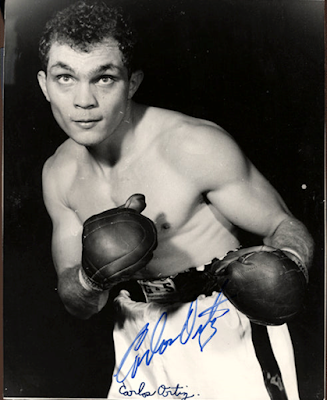
For me, the death of Carlos Ortiz on June 13, 2022, represents the end of an era. An era when many boxers trained with other boxers in remote training camps. Carlos Ortiz was the last in a long line of champions that trained at a boxing camp in the small, idyllic town of Chatham Township, New Jersey. It was a camp that was started by a woman, Madame Bey, in 1923, and continued by Ehsan Karadag after her death in 1942. There is no telling how many champions passed through this camp; however, we do know that there were no fewer than 14 heavyweight champions and 80 International Boxing Hall of Fame inductees that came to this camp from 1923 to 1969.

When Ortiz first came to the camp, he was following in the footsteps of a pantheon of great boxers. From the first to train here in 1923, middleweight world champion Johnny Wilson, to the last, Carlos Ortiz. Others in the forty-seven-year history that trained here were Gene Tunney, Max Schmeling, Mickey Walker, Henry Armstrong, Lou Ambers, Tony Canzoneri, Floyd Patterson (the last heavyweight champion to train here in 1959), and many other world champions. Other greats that had retired just came to the camp to watch their successors. Greats like Rocky Marciano, James J. Corbett, Jack Johnson, Jack Dempsey, Joe Louis, Benny Leonard, James Braddock, were among them. Along with the fighters, many great trainers, managers, and promoters accompanied them, like Cus D’Amato, Ray Arcel, Whitey Bimstein, Chris Dundee, Joe Jacobs, Mike Jacobs, Jimmy Jacobs (Mike Tyson’s co-manager), etc.

In 1966 and 1967, the last world champion came to use Ehsan’s camp as a base for his training. Like Freddie Welsh, who had brought boxing to Chatham Township in 1917, he held the world lightweight championship. His name was Carlos Ortiz, born in Ponce, Puerto Rico, on September 9, 1936. He came to mainland America in 1947. Ortiz had eyes that lit his face, even white teeth, tightly curling brown hair, and thick eyebrows dominating his tiny features. His face remained unmarked after eighteen years of fighting as an amateur and professional. 
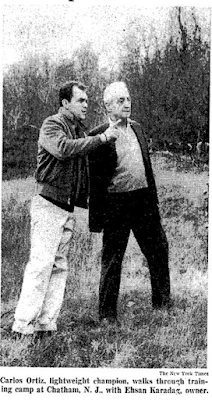
Ortiz held the world junior welterweight championship from 1959 to 1962, followed by two reigns as the world lightweight champion, from 1962 to 1965 and from 1965 to 1968. Most champions were training elsewhere. Some were in hotels like those in the Catskill Mountains. Muhammad Ali, world heavyweight champion, preferred to do his work in a midtown gymnasium, where the “people can come to see me,” thought later is his career he, too, would train in a remote camp in Pennsylvania.

“The Garden wanted to put me up there somewhere, too,” Ortiz said, “but there’s too many people there. I don’t like to be bothered when I’m training.” 

Ortiz was to defend his world lightweight title against Gabriel “Flash” Elorde from the Philippines at Madison Square Garden. It would be the first lightweight title bout at the Garden in almost thirteen years—since Paddy DeMarco, the Brooklyn Billy Goat, dethroned Jimmy Carter on March 5, 1954. 

The camp owner, Ehsan, was seventy-seven years old. He used to have many fighters training, sometimes over thirty, but now he was lucky to have three—Ortiz and two sparring partners. Ortiz also spent a few weeks at Ehsan’s earlier that year prior to his title bouts with Sugar Ramos and Johnny Bizzarro. Other than that, Ehsan’s Camp had been quiet.

The white, clapboard farmhouse at the camp that had housed a great many champions was weather-beaten. Inside, you could find Carlos Ortiz playing cards, which had been a tradition through the years. It was time to relax and forget about boxing for a while. Their game of choice that day was Hearts.

“Carlos is leading,” said Teddy Bentham, his trainer, looking up from the score pad.

“You've got to lead the spades to me,” Roger Gerson, a friend of Ortiz, said across the table to Willie Munoz, one of the sparring partners. “Then I can lead the spades to Carlos, and he can’t get off the hook.”

“I'm a good counter puncher,” Ortiz said, seriously, referring to the card game and not his boxing skills.

“Carlos wins a ten-dollar,” Bentham said, after the game concluded.

“Another big purse,” Carlos said, smiling.

At the conclusion of the game, Ortiz’s manager reminded him it was time to get back to work.

“I love this place,” Ortiz said. “I don’t want to train at those resorts. Too many people. That’s like going to Coney Island.”

Ortiz dominated the fight against Elorde at the Garden on November 28, 1966. He scored a knockout at two minutes, one second in round fourteen of fifteen. All scorecards showed Ortiz ahead before the knockout. Referee Jimmy Devlin eleven to two, Judge Joe Armstrong thirteen to zero, and Judge Artie Aidala twelve to one. The unofficial Associated Press scorecard was twelve to one, and the unofficial United Press International scorecard was eleven to zero with two even.

Arriving back at Ehsan’s in 1967, Ortiz came to prepare for another lightweight title defense. He would defend against the tall Panamanian, Ismael Laguna, a future lightweight champion.

“When I was a kid,” Carlos Ortiz said, “I promised myself I would make this title worth more money than it ever was worth before.”

With this fight, Ortiz would be able to fulfill his promise to himself. He was to fight for a guarantee of $83,000. When added to his lifetime earnings, it would eclipse by $500 the record for money earned by a lightweight, still held by Lou Ambers, who frequently used the camp to train for his fights thirty years before.

“But the money hasn’t changed Ortiz, said journalist Dave Anderson who was at the camp. “He trains the way champions used to, in seclusion and in simplicity. Other champions like their luxury these days.”

When asked what he would do with his purse, Ortiz said he would buy Ehsan’s Camp, and appeared serious.

“… I got to like it. I enjoy walking around here and the little town down the road, New Providence, is a nice place.”

On August 16th, Ortiz won a unanimous fifteen-round decision over Laguna at Shea Stadium in New York City, retaining his world lightweight title.

Ortiz would lose his title in his next fight against Carlos Teo Cruz in a fifteen-round split decision. He did not train at Ehsan’s for it. It took place on June 28, 1968, in Estadio Quisqueya, Santo Domingo, Dominican Republic. Ortiz would go on to win his next ten fights after that loss. In 1972, he was scheduled to fight Roberto Duran, who was the lightweight champion, but Duran withdrew ten days before the fight. Ortiz fought Ken Buchanan instead.

“I had trained for a completely different fighter and was very frustrated. I felt I had nothing to gain and everything to lose,” Ortiz said.

On September 20, 1972, thirty-five-year-old Ortiz fought Buchanan at Madison Square Garden. Ortiz did not get up from his stool after the sixth round. He lost by a technical knockout. For the first time in his career, he did not finish a fight.

“I knew this was going to be my last fight,” Ortiz said. 

It would be his last fight. One month later, Ehsan Karadag died at the age of eighty-two. 

Carlos Ortiz finished his career with a record of 61-7-1 and one no contest. Ortiz is considered among the best Puerto Rican boxers of all time by sports journalists and analysts. He holds the record for the most wins in unified lightweight title bouts in boxing history at ten. In 1991, Ortiz was inducted into the International Boxing Hall of Fame. In 2002, Ortiz was voted by The Ring magazine as the 60th greatest fighter of the last 80 years. He held 21st place in BoxRec ranking of the greatest pound-for-pound boxers of all time.

In 1969, Willie Ratner, the journalist who coaxed Madame Bey into assuming Freddie Welsh’s business forty-six years before, came to visit the camp. Where the sign that used to hang for a passerby to read “Training To-Day” was a new sign— “For Sale.” 

During its existence, the camp was the best known in the world. Time, economics, suburban sprawl, and a changed world of boxing took their toll. Its past popularity was undeniable. The once sparsely populated farmland was now surrounded by suburban homes and a large apartment complex down the street.

In 1972, the farmhouse on the grounds was razed, and the gymnasium was remodeled into a ranch-style house to blend with the surroundings. The extraordinary events that occurred at the camp live on because of fighters and sportswriters of the past, like Carlos Ortiz.


Gene Pantalone and his three brothers visited the historic camp in the mid-60s to see the likes of boxers Carlos Ortiz, Rubin Hurricane Carter, Jose Torres, Benny Kid Paret (he trained for his fatal fight there), Issac Logart, and Doug Jones. His books include Madame Bey’s: Home to Boxing Legends and From Boxing Ring to Battlefield: The Life off War Hero Lew Jenkins.

Gene Pantalone has compiled the following alphabetical list of known boxers, trainers, managers, promoters, and celebrities that attended the camp based on photograph and newspaper archival evidence. The following is an alphabetic list of people associated with boxing that were in Chatham Township, New Jersey, where Madame Bey's camp resided:

Georgie Abrams, Lou Ambers, Fred Apostoli, Red Applegate, Ray Arcel, Freddie Archer, Henry Armstrong, Buddy Baer, Max Baer, Joe Baksi, Sam Baroudi, Billy Beauhuld, Tommy Bell, Steve Belloise, Paul Berlenbach, Melio Bettina, Carmine Bilotti, Whitey Bimstein, Jimmy Bivins, James Braddock, Jorge Brescia, Jack Britton, Freddy Brown, Al Buck, Red Burman, Mushy Callahan, Victor Campolo, Tony Canzoneri, Primo Carnera, Georges Carpentier, Jimmy Carter, Rubin Carter, Ezzard Charles, Kid Chocolate, Gil Clancy, Freddie Cochrane, Jimmy Carrollo, James J. Corbett, Lulu Costantino, Cus D’Amato, Jack Delaney, Al Davis, Red Top Davis, James P. Dawson, Jack Dempsey, Gus Dorazio, Carl Duane, Chris Dundee, Johnny Dundee, Vince Dundee, Sixto Escobar, Tommy Farr, Abe Feldman, Freddie Fiducia, Jackie Fields, F. Scott Fitzgerald, Billy Fox, Humbert Fugazy, Charley Fusari , Tony Galento, Kid Gavilán, Frankie Genaro, Billy Gibson, Joey Giardello, George Godfrey, Arturo Godoy, Charley Goldman, Ruby Goldstein, Bud Gorman, Billy Graham, Frank Graham, Rocky Graziano, Abe Greene, Gus Greenlee, Emile Griffith, Babe Herman, Steve Hostak, Ace Hudkins, Herbert Hype Igoe, Beau Jack, Tommy Hurricane Jackson, Jimmy Jacobs, Joe Jacobs, Mike Jacobs, Joe Jeanette, Ben Jeby, Lew Jenkins, Jack Johnson, James Johnston, Doug Jones, Ralph Tiger Jones, Phil Kaplan, Jack Kearns, Frankie Klick, Johnny Kilbane, Solly Krieger, Jake LaMotta, Tippy Larkin, Benny Leonard, Gus Lesnevich, King Levinsky, John Henry Lewis, Isaac Logart, Tommy Loughran, Joe Louis, Joe Lynch, Eddie Mader, Nathan Mann, Rocky Marciano, Lloyd Marshall, Eddie Martin, Bat Masterson, Joey Maxim, Jimmy McLarnin, Mike McTigue, Jack Miley, Bob Montgomery, Archie Moore, Tod Morgan, Dan Morgan, Walter Neusel, Kid Norfolk, Lou Nova, Jack O’Brien, Bob Olin, Lee Oma, Carlos Ortiz, Ken Overlin, Benny Kid Paret, Floyd Patterson, Willie Pep, Billy Petrolle, Willie Ratner, Grantland Rice, Gilbert Rogin, Maxie Rosenbloom, Al Roth, Andre Routis, Irving Rudd, Bobby Ruffin, Damon Runyon, Sandy Saddler, Lou Salica, Johnny Saxton, Max Schmeling, Flashy Sebastian, Marty Servo, Jack Sharkey, Battling Siki, Eric Seelig, Freddie Steele, Allie Stolz, Young Stribling, Herman Taylor, Lew Tendler, Sid Terris, Young Terry, Jack Thompson, Jose Torres, Gene Tunney, Pancho Villa, Mickey Walker, Max Waxman, Al Weill, Charlie Weinert, Freddie Welsh, Harry Wills, Charley White, Johnny Wilson, Chalky Wright, Paulino Uzcudun, Jersey Joe Walcott, Ike Williams, Teddy Yarosz.


Sources:

Anderson, Dave. Ortiz Prefers Simple and Secluded Training. New York Times. November 27, 1966.

Hissner, Ken. Carlos Ortiz the Hall of Fame Junior Welterweight and Lightweight Champion! Doghouse Boxing. April 28, 2009.

Ratner, Willie. Ehsan’s Training Camp on the Ropes. Newark Evening News. April 23, 1969.

Norton, Mark. Letter to the Summit Historical Society. Summit: 2008.

Smith, Red. Carlos Comes High. Binghamton Press. August 11, 1967.

Friday, October 30, 2020

Female Boxing Pioneer Finally Gets Monument in Chatham Cemetery

By Matt Ward

Hranoush Sidky Bey, known as Madame Bey, ran a successful boxing camp in Chatham that was frequented by the legendary fighters of her day.

On a cool day in September, a private ceremony was held to honor female boxing pioneer, Hranoush Sidky Bey. The small gathering, at the Fair Mount Cemetery, included family members, representatives from the New York Turkish Consulate General, local boxing historians, Chatham Township Historical Society members, and local elected officials. 

Commonly known as Madame Bey, she came to the United States at the age of 16 with her future husband, Mehmed, a Turkish diplomat. Prior to becoming an important figure in professional boxing circles, Bey was already a "Renaissance woman." She was well-educated, spoke seven languages, sang opera, and was a fixture in the Washington, D.C. social scene. It was in Washington, D.C. that she and her husband became friends with President William McKinley. She was just a few feet away from McKinley when he was assassinated in Buffalo in 1901. 

Madame Bey ran her training camp in Chatham Township, New Jersey from 1923 until her death in 1942. Notable visitors to her camp included world champion boxers Jack Johnson, Jack Dempsey, Gene Tunney, Max Schmeling, Lou Ambers, Primo Carnera, Joe Louis, and Floyd Patterson. Madame Bey's life inside and outside of her boxing camp is chronicled in New Jersey boxing historian Gene Pantalone's 2016 book, Madame Bey's: Home to Boxing Legends.

Since publishing his book, Pantalone has been a vocal advocate for honoring Madame Bey's contributions to the boxing world. His research, writing and talks have made him a "go to guy" for all things Madame Bey, and his efforts have brought her contributions to the history of boxing back to the forefront of the sports world. 

"Imagine, a woman in the 1920s, just 3 years after the 19th amendment gave women the right to vote in the US, running a successful business in a man’s world in a sport thought of as only men could be involved in. Throughout its existence, the camp saw no fewer than 14 world heavyweight boxing champions and 80 hall-of-famers. It was the most famous boxing camp at the time. It is a feat that would be hard to duplicate even in today’s world," Pantalone told Patch. 

While researching his book, Pantalone, a resident of New Providence, discovered that Madame Bey and her husband were laid to rest in nearby Fair Mount Cemetery without a grave marker. Soon after making this discovery, Pantalone and the Chatham Township Historical Society became actively involved with Bey's descendants, local historians and the Turkish Consulate General to raise funds and plan for the placement of a tombstone for Madame Bey and her husband. The project to place a tombstone over the previously unmarked grave was completed on September 20, 2020. 

Madame Bey was also honored earlier this year by the New Jersey Boxing Hall of Fame when she was selected to be inducted into the hall of fame with the class of 2020. Unfortunately, this year's induction ceremony and banquet was postponed until November of 2021 due to restrictions associated with the COVID-19 pandemic.

When asked what Madame Bey means to the history of boxing, New Jersey Boxing Hall of Fame president Henry Hascup said, "Madame Bey's induction into the New Jersey Boxing Hall of Fame is long overdue! Here's a lady who knew nothing about boxing, and then went on to build one of the top boxing camps in the history of the sport. There were times when there were ONLY eight recognized World Champions, and she had over half of them training at her camp."

This story also appeared on Patch

Support The Weigh-In: Your Home for Combat Sports by Shopping World Wrestling Entertainment (WWE) Products!

Tuesday, September 22, 2020

Pandemic Knocks Out Annual Boxing Banquet


The 2020 New Jersey Boxing Hall of Fame's annual induction and awards ceremony has been canceled due to the COVID-19 pandemic.

For the first time in its 52-year history, the New Jersey Boxing Hall of Fame Induction and Awards Dinner has been canceled.

The annual early November induction and awards dinner, held in recent years at the Venetian in Garfield, has attracted upwards of 650 people. This year's banquet was officially canceled as the COVID-19 pandemic continues to pose a health threat to New Jersey residents.

In a recent press release, New Jersey Boxing Hall of Fame President, Henry Hascup, stressed the need for attendee safety, and to have maximum support for those being honored by the hall of fame. "Right now the [New Jersey] Governor has opened it up to 25% of the venue's capacity, but that would mean that ONLY 250 people could attend, which wouldn't be fair to the honorees," Hascup said.

The New Jersey Boxing Hall of Fame was established in 1968 to honor persons who made significant contributions to boxing in New Jersey. Inductees span the various roles involved with the sport ranging from fighters to medical professionals.

This year's 14 inductees include a variety of boxers and non-boxers. Bob Rooney Jr. and David Toledo headline the list of boxers from the Garden State. Non-participants joining the hall of fame include sports photographer, Ed Mulholland, and boxing training camp owner, Madame Bey.

The Turkish-born Hranoush Sidky Bey, commonly known as Madame Bey, ran her training camp in Chatham Township, New Jersey from 1923 to 1942. Notable visitors to her camp included Max Schmeling, Primo Carnera and Lou Ambers. Madame Bey's life in and outside of her boxing camp is chronicled in New Jersey boxing historian Gene Pantalone's 2016 book, Madame Bey's: Home to Boxing Legends.

The class of 2020 inductees will be honored on November 11, 2021 with the class of 2021.

The New Jersey Boxing Hall of Fame is a 501-C3 charity. Notable past inductees include, Mickey Walker, Jersey Joe Walcott, Mike Tyson, James J. Braddock, Gerry Cooney and Marvin Hagler.

For more information on the New Jersey Boxing Hall of Fame and the class of 2020, please visit their official website and Facebook page.

This story also appeared on Patch


Support The Weigh-In: Your Home for Combat Sports by Shopping World Wrestling Entertainment (WWE) Products!

Tuesday, May 7, 2019

The Carnival of Champions

By Gene Pantalone

Author of From Boxing Ring to Battlefield: The Life of War Hero Lew Jenkins
Available on Amazon

“This is a superb book that I highly recommend to all boxing fans. It is a great read.”
(Al Bernstein, Hall of Fame Boxing Analyst, Showtime)

From Boxing Ring to Battlefield is an engaging read. Katie Jenkins. . . comes across as a particularly interesting character. . . . I knew next to nothing about Lew Jenkins when I started reading From Boxing Ring to Battlefield. I feel as though I know him much better now. (Thomas Hauser, Boxing Writers Association of America Nat Fleischer Award, author of book Missing nominated for four Academy Awards)


In July 1937, promoter Mike Jacobs, who at the time was such a dominate promoter he was known as Mr. Boxing, had the idea to put together an unprecedented boxing card with four championship bouts. He would promote it as the Carnival of Champions. Jacobs committed to four title fights to be staged at the Polo Grounds where the New York Giants baseball team played their home games. The four championship bouts would match world lightweight champion Lou Ambers against Pedro Montañez, world welterweight champion Barney Ross against Ceferino Garcia, world bantamweight champion Sixto Escobar [the first native of Puerto Rico to hold a title] against Harry Jeffra, and French middleweight champion Marcel Thil against Fred Apostoli. Before the fight date arrived, controversy arose over the middleweight bout. Thil regarded himself as the world middleweight champion. The New York State Athletic Commission (NYSAC) recognized Freddie Steele as the champion. Under NYSAC compulsion, both boxers had to sign an agreement stipulating that no title would be at stake if they wanted to fight in New York.

Jacobs signed a contract stipulating for him to pay lightweight champion Lou Ambers $65,000 with an opportunity of 20 percent of the gate. It was an all-time high guarantee for a lightweight. In time, Jacobs had every fighter signed to an elaborate scale. Besides Ambers’s contract, he signed his challenger, Montañez, for $40,000. He signed Ross for $35,000, Thil $30,000, Escobar $12,500, Garcia $5,000, Apostoli $5,000, and Jeffra $2,500. If his receipts reached the $350,000 mark, Jacobs predicted he stood to realize a sizable profit. Though not a large sum of money by today’s standard, in 1937 it was exorbitant. Jacobs did not ignore his philanthropy for the event. He committed 10 percent of his profits to the House of Calvary Cancer Hospital.

Mike Jacobs had committed about $200,000 of his own money. He believed that with the Polo Grounds tickets scaled from $3 to $16.50, he might achieve a gate of $500,000. When it was suggested that a financial loss on the event was a possibility, he grinned and shrugged.
“What of it?” he said. “We’ll all have a lot of fun, won’t we? We’ll see some good fights and give a lot of fellows some work.”

Three of the Carnival of Champion fighters trained at Madame Bey’s boxing camp in Chatham Township, New Jersey, and another three trained at Dr. Bier’s camp in Pompton Lakes, New Jersey, where Joe Louis trained for most of his fights. World lightweight champion Lou Ambers, world bantamweight champion Sixto Escobar, and middleweight challenger Fred Apostoli all trained in Chatham Township. Whitey Bimstein, who was in the corner of more champions than anyone in the history of boxing, trained all three. Ceferino Garcia, Marcel Thil, and Pedro Montañez trained in Pompton Lakes.

Ceferino Garcia, Marcel Thil and Pedro Montañez at their training camp before the fight in Pompton Lakes, NJ.

For the lightweight title bout, Charley Goldman, better known as a trainer, was Ambers’s new manager succeeding Al Weill [Weill would become Ambers’s manager again after this event]. Goldman and Weill would collaborate to campaign many fighters, including undefeated world heavyweight champion Rocky Marciano.

Journalists, photographers, and fans inundated the Bey camp before the Carnival of Champions date. One of the most remarkable facets of the training of Lou Ambers, Sixto Escobar, and Fred Apostoli at Madame Bey’s was the friendliness among them in the camp. When the press was told they would share Madame Bey’s camp for the Carnival of Champions, many anticipated that animosity would result. Nothing transpired. Madame Bey, who ran the camp, structured their training to avoid conflict. Escobar started first at one o’clock, Ambers followed at two o’clock, and Apostoli at three o’clock. Just one happy family, a reporter said.

Madame Bey talking to Mike Jacobs at her boxing camp.
On September 13, Al Buck reported on the fighters for the New York Post. He asked Ambers if he thought he had won the night Montañez received a close and disputed decision in their previous ten-round nontitle bout at Madison Square Garden. Ambers, ever the sportsman, gave his reply.
“I don’t know,” Ambers answered. “I never know who is winning when I’m fighting.”
Ambers was asked how he liked his new manager, Charley Goldman.
“Fine,” Ambers said as he winked. “Swell.”

Goldman said nothing. Heavyweight Tony Galento, Dumb Dan Morgan, a former manager, Kid McPartland, the former lightweight boxer who retired in 1905 and now was a boxing judge and referee, Al Weill, and manager Joe Jacobs, who had managed Andre Routis, Max Schmeling, and Tony Galento, were also at the camp. Weill asked how Ambers looked.

“Better than he’s looked for some time, but he gets hit with too many right hands,” Joe Jacobs observed. “I counted ten during the three rounds he boxed with Augie Gonzales.”

“I’m rolling with ’em, Joe, and I’m not quite right yet,” Ambers explained to Joe Jacobs. “Gonzales is a smart young fellow, and I honestly only felt three of his punches.”

On one day, the press asked Whitey Bimstein, trainer of all three at Bey’s camp, about the bouts.

“The winners?” Whitey said. “They’re all here, Escobar, Ambers, and Apostoli.”

Sixto Escobar with Whitey Bimstein.
As the big event neared, and thinking of ways to maximize the revenues, promoter Mike Jacobs made a shift in the order of the fights for the Carnival of Champions at the Polo Grounds. Marcel Thil of France would open the event against Fred Apostoli. Jacobs said he changed the fight order to enable European newspapers to receive news of the fight some hours earlier than if it had been later. In the second bout, he put the Barney Ross match with Ceferino Garcia. The third bout would be Lou Ambers against Pedro Montañez. The finale would be Sixto Escobar and Harry Jeffra. A preliminary bout would open the program at 7:45 in the evening, and the Thil-Apostoli bout would begin at 8:10.

On September 23, 1937, Mike Jacobs held his Carnival of Champions at the Polo Grounds. It was an unprecedented event in boxing history. The event started on time at 7:45 with a four-round preliminary bout of such little importance that Mike Jacobs forgot to list the fighters [it was a lightweight bout between Young Chappie and Auggie Gonzales that resulted in a draw]. Amongst the crowd of 45,000 were governors, United States senators and congressmen, mayors, judges, lawyers, bankers, stockbrokers, industry leaders, society people, stage and screen stars, and figures from many fields of sport. WNBC broadcast the event over the radio. It was fifty-five rounds of championship fights. Not one knockdown occurred.

In the first title fight of the night, though only the Boxing Federation of Europe considered it a championship bout, Fred Apostoli, in the only fight not to go fifteen rounds, defeated Marcel Thil. The Frenchman was stopped in the tenth round with a severe cut over his right eye. Thil led on the scorecards at the time of the stoppage. This was the thirty-two-year-old Thil’s final career bout. Apostoli, along with most of boxing, considered Freddie Steele the world middleweight champion. Apostoli could not claim the title.

Fred Apostoli and Marcel Thil bout.
In the second title bout, Barney Ross broke his left hand during his bout yet still retained his welterweight title with a unanimous decision over Filipino Ceferino Garcia, who claimed Ross head-butted him. “In as masterful an exhibition of boxing, as admirable a demonstration of fighting courage and as determined a stand a champion has flashed in recent years, Ross matched his wits against the power of his challenger’s punches and won the unanimous decision,” reported the New York Times.

Barney Ross and Ceferino Garcia bout.
Next, Lou Ambers retained his lightweight title by avenging his previous loss to Montañez. Both judges gave Ambers the edge, with the referee scoring it even. The unofficial Associated Press scorecard had it overwhelmingly for Ambers with a 12-1-2 score. “At every turn... the shifty, unorthodox Ambers was the master,” reported the New York Times.

Lou Ambers sang in his dressing room, as he often did, “Put on your old gray bonnet with the blue ribbons on it.”

“Save those gloves,” Ambers shouted, hardly missing a note in his song and then started to dance. He traveled to his hometown of Herkimer, New York, after the bout with his brothers Joe and Angelo, his friend Father Gustave, and a lucky pair of boxing gloves.

Lou Ambers and Pedro Montañez bout.
Sixto Escobar lost his bantamweight title to Harry Jeffra in a lopsided match to the surprise of many. Jeffra “so far outclassed Escobar as to make the match surprisingly one-sided,” reported the New York Times. Harry Jeffra, despite winning, complained because he fought around midnight. Escobar also stated his annoyance claiming the delay made him cold.

“Ten o’clock’s my bedtime,” Jeffra declared.

Sixto Escobar and Harry Jeffra bout.
Of the 45,000 in attendance, 32,600 were paying customers. The gross receipts were $232,644. After the $20,000 stadium rental and other expenses, the net amounted to $198,634. After paying the $190,000 guarantees to the fighters, Mike Jacobs had a little profit, but it set future matches for Jacobs that made the night worth it.

A video of the event exists on YouTube that was uploaded by the Boxing Hall of Fame Las Vegas.

Photos used in this article is in accordance with Title 17 U.S. Code §107. Limitations on exclusive rights: Fair use.


Support The Weigh-In: Your Home for Combat Sports by Shopping World Wrestling Entertainment (WWE) Products!

Thursday, January 10, 2019

Lew Jenkins: An Improbable Story of Redemption

By TWI Staff 

Check out Luis Cortes' recent feature article for The Sweet Science on boxing historian and TWI contributor, Gene Pantalone's latest book, From Boxing Ring to Battlefield: The Life of War Hero Lew Jenkins.

Lew Jenkins: An Improbable Story of Redemption


Support The Weigh-In: Your Home for Combat Sports by Shopping World Wrestling Entertainment (WWE) Products! 

Tuesday, January 1, 2019

Happy New Year from the Weigh-In: Young Stribling’s 1924 New Year’s Day Bout with Dave Rosenberg

By Gene Pantalone

Author of From Boxing Ring to Battlefield: The Life of War Hero Lew Jenkins


Available for order on Amazon and from Rowman and Littlefield

“Too often the history of boxing boils down to tales about heavyweights, as if the exploits of Sullivan, Johnson, Dempsey, Louis, Marciano, Ali, and Tyson are all that matter. Well, Lew Jenkins—lightweight champion, war hero, and a danger to himself as much as any opponent—mattered. His is the story of survival in the ring, in two wars, and in life. Gene Pantalone’s biography of Jenkins richly recounts a fascinating life. ‘Only in America,’ as the great Don King always said.”

-Randy Roberts, professor of history, Purdue University, author, Joe Louis: Hard Times Man, and co-author, A Season in the Sun: The Rise of Mickey Mantle
Young Stribling and Jack Dempsey publicity photo.

In late 1923, William Lawrence “Young” Stribling, the pride of Georgia, had just turned nineteen one day before coming to the Long Hill Health Farm of former lightweight champion Freddie Welsh in Chatham Township, New Jersey. The brown-haired, blue-eyed, good-looking kid was a promising boxer. Stribling’s boxing was a family undertaking. His father managed him, and his mother was known to aid in his training. He arrived at Welsh’s to prepare for a New Year’s Day bout against Dave Rosenberg. He hoped to train with his idol, Jack Dempsey, who was a good friend of Freddie Welsh and had used his farm to train for bouts including the first million-dollar gate against Georges Carpentier. Stribling was a seasoned boxer despite his age. He began boxing professionally at the age of sixteen, compiling a record of 67 wins, 3 losses, and 13 draws before arriving at Welsh’s, a career for most boxers. Stribling would have a long, prolific career. He would compile a record of 223 wins, 13 losses, 14 draws, and another 39 newspaper fights. One year he fought 45 times. In total, he fought 291 bouts knocking out 129 opponents, a knockout record only surpassed by two people, Billy Bird and Archie Moore.

Welsh gave the Striblings a wheelbarrow for a publicity photograph. It appeared in newspapers showing Young Stribling pushing Ma and Pa Stribling, which the press dubbed them, and one other person. While there, he fulfilled his wish of training with the heavyweight champion. The youthful Stribling impressed Dempsey with his skills.

On January 1, 1924, despite being the underdog, Stribling defeated Rosenberg. He received a twelve-round decision at the First Regiment Armory in Newark, New Jersey. He won almost every round. Stribling fought six times that January. He won every bout except one he lost on a disqualification. In the loss, he was in the lead, but after repetitive cautions for hitting on the break, referee Phil Pritchard disqualified him. His father then hit the referee. Stribling fought thirty-six times in 1924, losing three bouts.

Young Stribling was the only man that Max Schmeling successfully defended his heavyweight title against. Schmeling trained in Conneaut Lake Park, Pennsylvania, for the July 3, 1931, Stribling heavyweight title bout. The fight was first scheduled in Chicago but changed to Cleveland. Stribling’s camp in Geauga Lake, Ohio, was ninety-three miles away from Schmeling’s camp.

Stribling, being a pilot, and accompanied by a New York newspaperman, borrowed a friend’s plane in Akron, Ohio. Stribling flew over his training camp and then proceeded to the Pennsylvania border and Schmeling’s camp. Schmeling was in the ring sparring in the second round with George Panka of Pittsburgh when Stribling flew his plane overhead. The plane was not more than two hundred feet above the spectators as they gasped. He returned twice to repeat the bold feat and then hurried back to the Cleveland airport to receive a reprimand from his father.

“It seems that Stribling broke away from the apron strings,” Nate Lewis said, a Stribling camp member. “He probably will do the same thing when he gets into the ring with Schmeling Friday.”

On July 3, 1931, the two met for the world heavyweight championship. Stribling was no longer the teenager that had come to Freddie Welsh’s Long Hill Health Farm to train. He was twenty-six years old and now had a record of 238 wins, 13 losses, and 17 draws. Schmeling was less than a year younger. They fought at Cleveland’s new Municipal Stadium on the shore of Lake Erie before an estimated 35,000 spectators. The disappointing crowd occupied a third of the big double-decked structure. The gate approximated at $323,000 was one of the lowest in heavyweight title history since the post-World War I boom days began. The depression that started in 1929 was affecting boxing.

Schmeling had Stribling bruised and bleeding in the last half of the fight. In the fifteenth and final round, Schmeling connected with his lethal right to Stribling’s chin. Stribling went down and looked unable to rise but beat the count at nine while clutching onto the ropes. He appeared out on his feet. Schmeling dashed toward him while the crowd yelled, “Stop it!” With fifteen seconds left in the round, Stribling’s father tossed in the towel. Referee George Blake stopped the fight, lifting Schmeling’s arm in victory. It was a technical knockout in the fifteenth round for Schmeling. A boxer for the first time stopped Young Stribling. Schmeling was euphoric but brought the stunned Stribling to his corner.

After the fight, Stribling said it was an injustice to stop the fight with fourteen seconds left. Stribling argued that Schmeling knocked him down only once, and he might have continued to the end. The Garden crowd, including his father, saw Stribling was in no state to continue, and another vicious hit could have caused a severe injury. Boxing finally recognized Schmeling as the legitimate titleholder. The Ring magazine declared their bout the 1931 Fight of the Year. The New York State Boxing Commission finally had Schmeling’s name engraved on the Tunney-Muldoon Trophy for heavyweight champions, which they had denied him after he won the title on a disqualification against Jack Sharkey.
Photo of the heavyweight title fight between Young Stribling and Max Schmeling.


Stribling’s last fight was a win over “Slapsie” Maxie Rosenbloom in 1933. In October of that year, Stribling was struck by a car while riding his motorcycle on his way to the hospital to visit his wife and newly born baby. Stribling’s foot was badly mangled, but he said, “I guess this means more roadwork.” Physicians were astonished at his ability to hang on to life with a temperature of 107.5 degrees and pulse of 175. He was given a last privilege to see his wife and baby at the same hospital before he died two days later. He was inducted into the International Boxing Hall of Fame in 1996.
Young Stribling and his wife, Clara, on board their cherished Indian motorcycles in Macon, GA, c. 1930.

Support The Weigh-In: Your Home for Combat Sports by Shopping World Wrestling Entertainment (WWE) Products!


Wednesday, November 21, 2018

Gene Pantalone Interview

Check out my interview with boxing writer and historian Gene Pantalone! Gene is the author of the brand new book on fighter and war hero Lew Jenkins, From Boxing Ring to Battlefield: The Life of War Hero Lew Jenkins

Gene Pantalone is an expert on the golden age of boxing—1920 to 1950—and Madame Bey’s boxing camp, which hosted fourteen heavyweight champions and no fewer than eighty International Boxing Hall of Fame inductees. He is a contributing writer to the boxing website The Weigh-In and author of Madame Bey’s: Home to Boxing Legends.

PODCAST:

Gene Pantalone Discusses his New Book on Fighter and War Hero Lew Jenkins on SoundCloud

Gene Pantalone Discusses his New Book on Fighter and War Hero Lew Jenkins on iTunes


Book Summary from Amazon.com:

From Boxing Ring to Battlefield: The Life of War Hero Lew Jenkins
GENE PANTALONE - FOREWORD BY JOHN DISANTO

World champion boxer Lew Jenkins fought his whole life. As a child, he fought extreme poverty during the Great Depression in the depths of the Texas Dust Bowl. In his twenties, he fought as a professional boxer and obtained the pinnacle of his vocation—a world championship. Jenkins fought in World War II and the Korean War, and in his later years, he fought the ravages from the aging of an abused body.

From Boxing Ring to Battlefield: The Life of War Hero Lew Jenkins details for the first time the extraordinary life of Lew Jenkins, from his difficult childhood to his death in 1981. Despite his talent for boxing, Gene Pantalone reveals that Jenkins often fought and trained through drunken stupors. After wasting his ring title and all his money, Jenkins found purpose during World War II and the Korean War. He fought in major battles that included D-Day, Bloody Ridge, and Heartbreak Ridge, and his efforts earned him one of the highest decorations for bravery, the Silver Star. Unable to find meaning in life at the peak of his boxing success, Jenkins discovered values to which he could cling during war.

From Boxing Ring to Battlefield features exclusive interviews with Lew Jenkins’ son, grandson, and Medal of Honor recipient Ronald E. Rosser who fought with Jenkins in the Korean War, providing a personal perspective on the life of this complicated war hero. The first biography of Jenkins, this book will fascinate boxing fans and historians alike.

Reviews and Endorsements:

"Too often the history of boxing boils down to tales about heavyweights, as if the exploits of Sullivan, Johnson, Dempsey, Louis, Marciano, Ali, and Tyson are all that matter. Well, Lew Jenkins—lightweight champion, war hero, and a danger to himself as much as any opponent—mattered. His is the story of survival in the ring, in two wars, and in life. Gene Pantalone’s biography of Jenkins richly recounts a fascinating life. ‘Only in America,’ as the great Don King always said."
-Randy Roberts, professor of history, Purdue University, and co-author, A Season in the Sun: The Rise of Mickey Mantle

"The life of Lew Jenkins is the stuff of boxing legend. From his Depression era upbringing and carnival barnstorming to winning a world title and squandering it all before becoming a war hero, Jenkins is an epic pulp novel come to life. In the capable hands of Gene Pantalone the story brims with all the hardscrabble detail you want in a great boxing book. This is a must-read for fans of the squared circle's history."
-Chad Dundas, sportswriter and award-winning author of Champion of the World

"I served in combat with Lew Jenkins during the Korean War when he received his Silver Star. Jenkins was a brave soldier who cared for his men. It was an honor to have served with him."
-Sergeant Ronald E. Rosser, Medal of Honor recipient, Korea 1951-52

"Lew Jenkins had a howitzer of a right hand and sometimes fought drunk. What more could you ask for?"
-Nigel Collins, ESPN Boxing analyst and columnist, International Boxing Hall of Fame inductee, and former editor-in-chief of The Ring magazine

"Until the publication of Gene Pantalone’s biography, the annals of boxing have been missing a chapter—a chapter on Hall-of-Famer Lew Jenkins. Jenkins was a bony Texan who, as a world lightweight champion, mastered the stylized warfare of the ring as well as the real thing—WWII and the Korean War. A must-read for all students of the history of the sweet science, Pantalone’s richly-documented biography presents an arresting portrait of a boxer and soldier who was as wild as a pirate and as courageous as Achilles."
-Gordon Marino, veteran boxing trainer and award-winning boxing writer for the Wall Street Journal and HBO Inside Boxing

"A full-length biography of boxer Lew Jenkins has been long overdue, and here Gene Pantalone does a good job of connecting Jenkins’ hardscrabble upbringing in rural Texas to the bright lights of Broadway to the grim realities of the battlefield. It’s an exceptional story of a fighter’s struggle, success, disgrace, and a sincere and hard-earned redemption."
-Clay Coppedge, author of Texas Singularities and Forgotten Tales of Texas

"Gene Pantalone has done a remarkable job bringing lightweight champ and Hall of Famer Lew Jenkins to life in this most entertaining and informative biography. "The Sweetwater Swatter" was one helluva hard puncher... so's his biographer."
-Clarence George, boxing writer and historian  

Purchase the Book:

Amazon.com

*DISCOUNTED* from Rowman & Littlefield Publishers


Ward and Pantalone


Support The Weigh-In: Your Home for Combat Sports by Shopping World Wrestling Entertainment (WWE) Products!